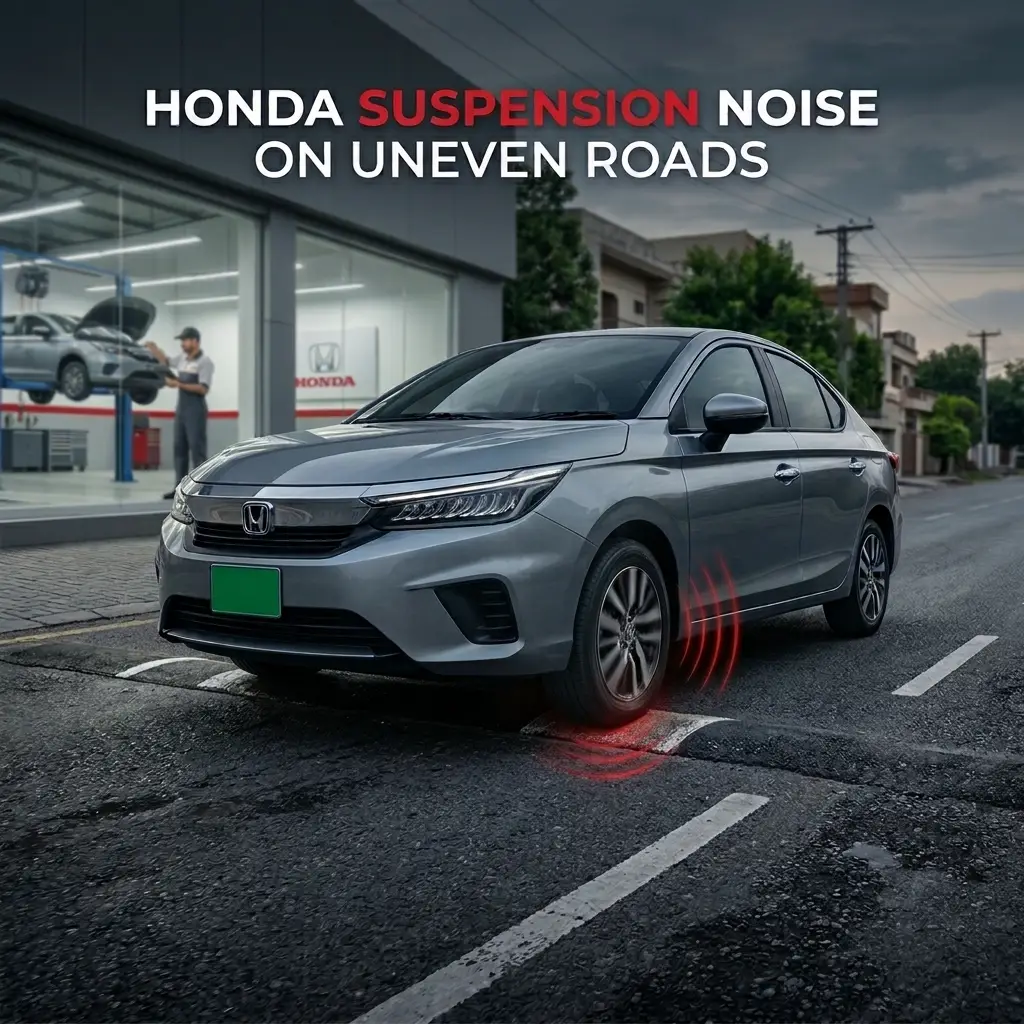
You’re on your way back in your Honda City. Traffic is crawling and you roll the car over the speed breaker. The moment the front wheels come down, there is a brief thud from underneath. A little later on the good stretch, you don’t notice it, yet on the next bump, you feel it again.
That noise can be irritatingly difficult to dismiss. Is it the suspension? Did a pothole hit something? Could something loose beneath the car be rattling whenever the body moves over a bump? The last thing you need is to go and shell out for parts and yet still hear the noise.
Anyone who has ever driven in Lahore or any other city in Pakistan would be familiar with the mix of smooth roads, repaired patches, uneven streets and sudden speed breakers. These jagged streets can make us more aware of a sound that has been lingering in the background. There can be many reasons for Honda suspension noise on uneven and rocky roads, and the same sound does not point to the same fault in every vehicle.
Here we show you what those noises might be telling you, what warning signs should trigger an immediate trip to the workshop, and how to approach a workshop visit without falling prey to false assumptions. This is a guide to typical concerns for Honda City, Civic, BR-V and HR-V owners. The main point to keep in mind: a mechanic has to inspect the actual car before confirming a faulty component.
Start with the Sound, Not a Replacement Part
You could hear a clunk and think, “Definitely the shocks.” The other person says, “No, it‘s the stabilizer links.” Neither could possibly know just from hearing the noise which part is failing.
A suspension system performs a number of functions. Springs in the system hold the body of the car up while the shock absorbers and struts control bouncing and the system components such as control arms and joints carry out wheel motion. Rubber bushings enable various parts to move without every bump passing through to the body and the steering system works in conjunction.
Excessive movement, broken mounts, or a loose connection may cause a knock or rattle. You’re not necessarily hearing a problem with the suspension, though – brake fittings, underbody panels, exhaust mountings, or loose equipment in the boot can all make a similar sound.
The most useful initial question is not, ‘Which part should I buy?’ It is, ‘Under exactly what conditions does the noise occur?’
What Different Suspension Noises Can Tell You
You are not required to use the individual names of all mechanical parts to define the difficulty clearly. Focus on the nature of the sound, and the situations that cause it.
A Solid Knock over a Speed Breaker
One particular clunking noise, when a wheel suddenly goes up or down a bump, could signal unwanted movement somewhere within the suspension or a nearby connection. Possible inspection points include control arm bushes, stabilizer links and strut mountings. If you predominantly notice it from the front, mention that, but keep in mind that sound travels through a vehicle’s body.
A Light Rattle on Broken Road Surfaces
Multiple smaller bumps in rapid succession could create a repeatedly metallic or plastic-sounding rattle. A stabilizer link could be the culprit, but loose brake hardware or an underbody panel also could be at fault. Pay attention to whether the sound disappears when driving on smooth asphalt, as that saves time diagnosing the problem.
Squeaking as the Car Moves
Systems that incorporate rubber bushings or moveable joints may squeak, but so can components outside the suspension system. Weather, movement, and the position of the vehicle can all influence what you hear. Hearing a squeak is a reason to investigate its source before deciding whether any shock absorber needs replacing.
A Noise during Turning or Braking
Should the noise be heard during a turn, the workshop might want to inspect the steering joints, tie rod ends, mounts and potentially even the drivetrain. If the noise is heard during a brake application, brake hardware might need to be inspected as well. Telling the mechanic whether it happens during braking, turning or a bump may be more useful than simply saying it is loud.
Eight Areas a Mechanic May Need to Check
These are potential causes, not a breakdown of part numbers your Honda necessarily needs. A qualified technician should be able to diagnose the cause of the abnormal sound and/or looseness and correlate it to the customer’s complaint prior to performing any repairs.
1. Shock Absorbers and Struts
What to expect following a bump in the road: the wheel moves, then the body should settle. The damper in a shock absorber or strut controls the bouncing that follows the bump. If the damper is no longer controlling that movement properly, a series of bumps may leave the car feeling unsettled.
You may detect too much bouncing, a variation in ride control or possible fluid leakage at the damper. Certain problems in the mounting may also generate a knock. But hearing the sound alone is no sure sign that the shock absorber has broken down. Before agreeing to a replacement, ask the technician to inspect both the damper itself and the points where it is attached.
2. Control Arm Bushings
These bushings sit between components which require some scope of movement. Rubber eventually deteriorates, cracks or wears, allowing more movement than it should. A clunk when you drive over a bump, or sometimes when accelerating and braking, can be a sign.
What matters is excessive looseness or damage, not merely evidence of aging in the rubber. When a mechanic suggests replacing a bushing, you can ask what the inspection revealed. These same principles discourage replacing many components if only one has been shown to be faulty.
3. Stabilizer Links
These linkages join different sections of the stabilizer bar system. Wear or looseness in a link can become audible as the wheels pass over short, abrupt bumps. You may even notice the noise on an uneven side street more than on a large speed breaker.
If your car rattles, it is quite easy to blame the stabilizer links because it is a common cause of a rattle. Nonetheless, the rattling sound might not be coming from the links themselves but rather from the mounting point of the links or some other part. The mechanic must identify the cause of the movement, not just change the link in hopes that the rattling sound stops.
4. Stabilizer Bar Bushings
Unlike stabilizer links, bushings hold the bar in position yet enable the movement necessary for its function. Wear or damage in these areas could generate noise when the suspension system operates from side to side.
If someone suggests replacing the entire stabilizer assembly, ask which part of the assembly has been tested. Testing might find a smaller issue, or it may find that the rattle was coming from somewhere else.
5. Strut Mounts
On cars equipped with struts, a mount attaches the assembly to the vehicle structure. If the mount is broken or loose, you could hear a knocking noise while driving over bumps. Depending on the design, it may also make a noise while steering.
Precisely how everything is set up can differ depending on the Honda model and model year. What someone experienced on an older Civic may not apply to your car. Essentially, the workshop must work with your vehicle’s specifications.
6. Ball Joints and Tie Rod Ends
This is a situation where a simple noise complaint can become a safety issue. These parts control movement of the wheels or steering. If this component is too loose, the vehicle’s response to driver input can be affected, as well as the sound.
A knock, combined with suddenly slack steering, difficulty controlling the car, or a strangely positioned wheel, needs to be looked at straight away. If in any doubt, don’t carry on driving as if it was OK to do so. Stop where it is safe to do so, and arrange for help. These components should be examined by an appropriate person.
7. Coil Springs and Their Seats
Springs support the weight of the car. A spring that is broken or has a problem in the seating area can impact the ride height and sometimes make a noise. A Honda that suddenly sits lower at one corner should not be treated as a normal cosmetic difference.
DO NOT try to disassemble a spring or strut assembly yourself. Springs are highly compressed and store a tremendous amount of energy that can cause serious injury if mishandled. Have the job done by a qualified technician.
8. Brake, Exhaust and Underbody Hardware
When you look for suspension clicking or rattling, remember the nearby parts first. Loose brake fittings, an exhaust mounting, or a plastic underbody shield can rattle or knock on rough roads. Unsecured spare-wheel equipment in the boot can produce metallic knocking that seems to come from beneath the car.
And that is why broad checks are important: you are after the source of the sound, not simply the most popular suspension component label.
Did the Noise Occur Subsequent to a Pothole Impact?
That’s worth noting. For example, you hit a deep pothole on your commute to work. Your Honda vehicle initially feels okay, but today you notice an odd thud, shimmy and pull to one side. That affects what the workshop will inspect.
A harsh contact could damage a tyre, rim, wheel, steering component or suspension component. It could alter the vehicle’s handling. It may be that not all potholes cause damage and not all after-pothole noises are from suspension but any obvious after-effects should be inspected thoroughly.
If you notice a bulge in the tyre, the steering is suddenly hard to turn or the car feels unstable, stop in a safe place and get help. For a less severe, infrequent noise without a control issue, have it checked instead of waiting weeks for it to go away.
Warning Signs That Matter More than the Noise Itself
You can hear the same rattle on multiple trips without noticing anything else. However, if one of the following changes occurs, be attentive:
- Loose or unpredictable steering. A change in steering response may be more serious than the associated sound.
- The car continuously pulls to one side. The cause could be anything from tyres and tyre pressures, to the wheels, brakes, steering, or suspension.
- Bouncing continues after a bump. If a loss of ride control is apparent, the dampers and other related components should be checked.
- A tyre tread is uneven. It is not necessarily alignment at fault, inspect tyre and other mechanical aspects.
- One corner sags. There could be an issue with the spring or other support member.
- A new noise follows a strong road impact. Specify the impact and any handling change.
- The knock is coming more frequently or is louder. A changing problem should not be left too long.
You don’t have to identify the faulty part from this list. Its usefulness is that it helps you decide to get the car checked over and gives your technician a broader picture.
When Should You Cease Your Driving?
If steering suddenly stiffens up, the wheel position is incorrect, the tyre is badly damaged, or the vehicle is unstable after impact, stop in a safe location. A loud mechanical noise that occurs together with poor control is also a sign to stop. It may be safer to be towed or get roadside assistance than continue to a workshop.
And a quiet, continual rattle? That’s a different story. It may not be an emergency, but it still needs a look. The best next move depends on the true state of the car, not whether the noise is loud or soft.
Why Pakistani Roads Make These Problems Noticeable
An ordinary drive in Lahore could be along a perfectly smooth main road, a street undergoing road work, a speed bump and a rough patch of blacktop. They’re all a few kilometres apart. The vehicle responds to each one differently.
Bumps are exactly what a suspension is there to handle. Problems develop when continual heavy hits, a build-up of wear, incorrect tyre pressure or a very heavy load affect how the suspension components work. Some noise can become noticeable on rough roads even if the underlying looseness developed over time.
A few simple practices are:
- Ease off as you approach a speed bump, instead of attempting to brake rapidly at the end.
- Leave safety gaps in time to be able to notice road hazards.
- Do not swerve dangerously for an obstacle like a pothole.
- Use the cold tyre pressure specified for your model of Honda, and adhere to the indicated load limits.
Same Advice for Honda City, Civic, BR-V and HR-V?
A diagnostic procedure is similar; the actual mechanical procedures are not by any means identical. For example the various models and earlier versions of the same model utilize different components, tyre sizes and suspension configurations.
A City owner might mention hearing a clunk over a speed breaker at slow pace. A Civic driver might mention a noise when turning into a parking lot. A BR-V / HR-V driver might mention a rattle after a rough-road trip. These are examples of how drivers might describe symptoms and not actual prevalent defects in any specific model Honda.
If you come across an internet argument that “this will always go wrong” on a particular vehicle, treat it as a clue at best. Knowing your year of manufacture, service history, previous repairs and the vehicle’s present condition is far more useful than a one-size-fits-all opinion.
The Truth Behind What Happens During a Valid Suspension Inspection.
The single best thing you can do is describe the problem to the workshop as accurately as possible. “It makes a noise in the front” – even a minor variation of this still leaves the workshop in the dark. “It makes one clang at the front when the left wheel descends a lip on a speed bump – and this problem‘s been there since I went into a pothole.”
A thorough investigation generally begins with questions: When did the noise start? Does it occur under braking or during a turn? Was any work performed on suspension or tyres lately? Has there been a change to the steering? If the vehicle was deemed safe for the road test, the sound should be able to be recreated. If there are handling concerns, a safe stationary check is then advised.
After that, there is the physical exam. The mechanic can examine the tyres and rims before moving to suspension joints, mountings, bushings, springs, dampers, steering links, and adjacent brake elements. They must verify whether there are signs of actual damage or excessive movement.
The workshop will be able to describe the repair and any tests involved once a fault has been detected. Some suspension or steering procedures will involve a wheel alignment check after completion, while others will not. How will the team check that the result has been achieved? Fitting a part is not the same as curing the issue.
A Quick Noise Diary Can Help
You do not need an app or a special form. Before your appointment, write down a few details:
| What to observe | An example of helpful information |
|---|---|
| Where you hear it | Front left, rear, or difficult to locate |
| When it happens | Speed breakers, uneven road, turning or braking |
| Type of sound | A single loud clunk, continuous rattle or squeak |
| When it first occurred | After hitting a pothole, after a repair, or over a period of time |
| Other symptoms | Steering pull, tyre wear, vibration or bouncing |
Please do not deliberately drive over rough obstacles to make the noise louder for a recording. An ordinary, safe description is enough to start the conversation.
Which Do You Need – Suspension Repair or Wheel Alignment?
The operations sometimes get mixed up since they are both related to the way vehicles behave when driving. Wheel alignment focuses on adjusting the angles of the wheels to the manufacturer’s specifications. Incorrect alignment may contribute to uneven tyre wear or a car pulling to one side.
A mechanical suspension knock is a different problem. Wheel alignment will not fix a faulty joint or damaged mounting. Similarly, a vehicle that pulls to one side does not necessarily need a suspension overhaul, and may simply have a tyre or pressure fault.
The service shop should ascertain the root of the problem before recommending any work. Honda Ring Road will offer details of the applicable suspension and steering inspection items connected with the Wheel Alignment service.
What is the Price for Honda Suspension Repair Lahore?
“Suspension knocking” cannot reliably be given a fixed price, as it is a symptom rather than a single repair. Tightening or repairing one fitting can take very different work from replacing a damaged mechanical part. The Honda model, model year, parts availability and labour all influence the quote.
In the event your workshop finds a problem, request an itemised estimate. It will inform you of what components will be needed, if they are suitable for your model, what the work will cover, and if a subsequent alignment or inspection is necessary.
One can reasonably ask for an explanation if several parts are listed. You are not challenging a technician when asking what the inspection revealed; you’re merely seeking an explanation of the work you are authorising. That discussion is significantly more beneficial than selecting a workshop merely based on an online quoted price sight unseen.
Small Habits That Can Save You an Unnecessary Workshop Visit
Not all suspension noise can be prevented, but a modest amount of care makes it easier to detect issues early.
Maintain tyre pressures at the recommended level. Do not use a pressure reading based on a similar model, or a visual assessment, to determine pressure. Consult your owner‘s manual or the label in your vehicle for the proper cold pressure.
Reduce speed ahead of obstacles. The aim is controlled driving, not sudden braking or dangerous swerving to prevent a sharp impact. When you cannot avoid a pothole safely, remain focused on controlling the vehicle.
After a heavy impact. When you are able to stop safely, listen for new or changed noises and look for visible damage to wheels or tyres. If there are noticeable changes to the steering, vibration or stability, seek professional help before continuing.
Don‘t overload. There are specific limits as to how much weight can be put in your Honda. Excess weight can alter how your car behaves and functions.
Keep Service Records. When a sound begins to return, an invoice for a recent tyre replacement, suspension fix or wheel alignment may be helpful.
Repeated noises should be paid attention to. If the car makes the same noise at the same bump in the road every morning when you come to work, the workshop will have a better clue than simply being told that the car sounds noisy.
What Can You Check Safely?
You can do a few quick checks with the vehicle parked on level ground: look for any obvious tyre damage, a bulge or unusual wear. Is one corner of the car noticeably lower? Secure all loose items and spare-wheel tools in the boot.
Pay attention to whether the noise comes with a change in the steering or braking of your car, too. That information can be really helpful even when you’re not sure where the noise is coming from.
What not to do is get under a vehicle supported by an unsuitable jack, or dismantle loaded suspension components. Springs store hazardous energy that can cause serious injury if released incorrectly. Steering joints also require proper inspection procedures. A visual inspection at home helps you describe what is wrong; it does not replace a mechanical diagnosis.
Before You Agree to Replace Parts, Ask These Questions
A repair decision should be based on what the workshop found. You can keep the conversation simple:
- Which part is defective and how do you know?
- Did you inspect nearby steering, brake and underbody components as possible sources of the noise?
- Should this part be replaced, or is another repair appropriate?
- Is this part appropriate for my Honda model and year?
- Will the repair need an alignment or other future inspection?
- What measures will you use to ensure that the problem has been fixed?
If the diagnosis is clear, these questions should be easy to answer. These can also be used to avoid buying parts that are irrelevant to the initial symptom.
Honda Ring Road: Where to Ask about an Inspection
When the knock or rattle comes back repeatedly, you may wish to ask for a professional inspection instead of selecting a repair on your own. Honda Ring Road’s published service information includes Car Inspection and Wheel Alignment, with suspension and steering-related inspection items listed among the services.
When you call Honda Ring Road, give the team your Honda model and manufacturing year, describe the noise, and mention any difference in handling or recent road impact. Confirm service availability, appointment requirements and fees directly with the dealership. Use the Honda Ring Road contact page for enquiries.
Frequently Asked Questions about Honda Suspension Noise
How come there is knocking over a speed breaker in my Honda?
The noise may be an indication of anything from a worn bushing, to a stabilizer link, a mount, loose hardware or something else nearby. The timing of the noise helps narrow down an inspection, but alone the sound cannot determine the failed component.
Can Worn Shock Absorbers Cause a Knocking Noise?
They can, especially if the damper is faulty or its mounts are faulty. You may also observe too much bouncing. However, it would be a mistake to replace shock absorbers without inspecting the rest of the assembly.
Why Is My Honda Rattling When I Drive Over Small Bumps and Quiet on Smooth Roads?
Multiple light bumps can reveal looseness in a link, mounting, brake part or underbody panel. Note the pattern and let the workshop reproduce it safely.
Will Suspension Noise Cease After Wheel Alignment?
Not if the noise is due to a broken or loose mechanical part. The workshop needs to check if the problem is suspension, alignment or something else before suggesting work.
Can I Drive with a Suspension Knock?
It depends on what is causing it and whether control is compromised. Stop safely and seek assistance if steering, wheel position, tyre condition or stability is abnormal. Persistent milder noises also require an inspection.
Can One Pothole Ruin My Honda’s suspension?
A sufficiently hard impact may damage a tyre, rim, steering or suspension component. Many impacts cause no damage. A new noise, vibration or change in handling after such an impact is the reason to have the vehicle inspected.
Why Might My Honda Be Pulling to One Side?
Possibilities include tyre pressure, condition, wheel alignment, brakes, steering and suspension. It is wise to have a mechanic examine the real reason rather than always assume it‘s nothing but an alignment issue.
How Often Should I Check The Suspension?
Stick to your Honda model and year schedule. Should a strange sound suddenly begin, or there‘s a new indicator of a problem after a jarring impact, don‘t wait until the next scheduled maintenance appointment.
Cost of Honda Suspension Fix in Pakistan
The cost depends on the confirmed fault, parts, model and labour. The workshop is able to provide you with a meaningful estimate once the car has been inspected. A figure online without diagnosis may be misleading.
Is It Possible To Repair a Suspension Knock at Home?
Look for any obvious tyre damage or loose items in the boot. Removing springs, working on steering joints or dismantling suspension units can be dangerous and requires the correct equipment and training. Leave mechanical repairs to the experts.
Final Thoughts: A Good Diagnosis Beats Guesswork
It is easy to assume you need a big repair when hearing a knock over a speed bump. It could be a worn suspension part or a loose fastener nearby; the point is to find out before spending money.
Look out for changes in steering, tyres and ride control. Be clear about when you notice the noise. If you feel the car is difficult to control, do not continue driving and seek assistance rather than risk it. And if the noise persists, it’s worth seeing a workshop even if the Honda seems to be driving fine.
For a Car Inspection enquiry in Lahore, review Honda Ring Road’s Car Inspection service and confirm the appropriate booking with the dealership.