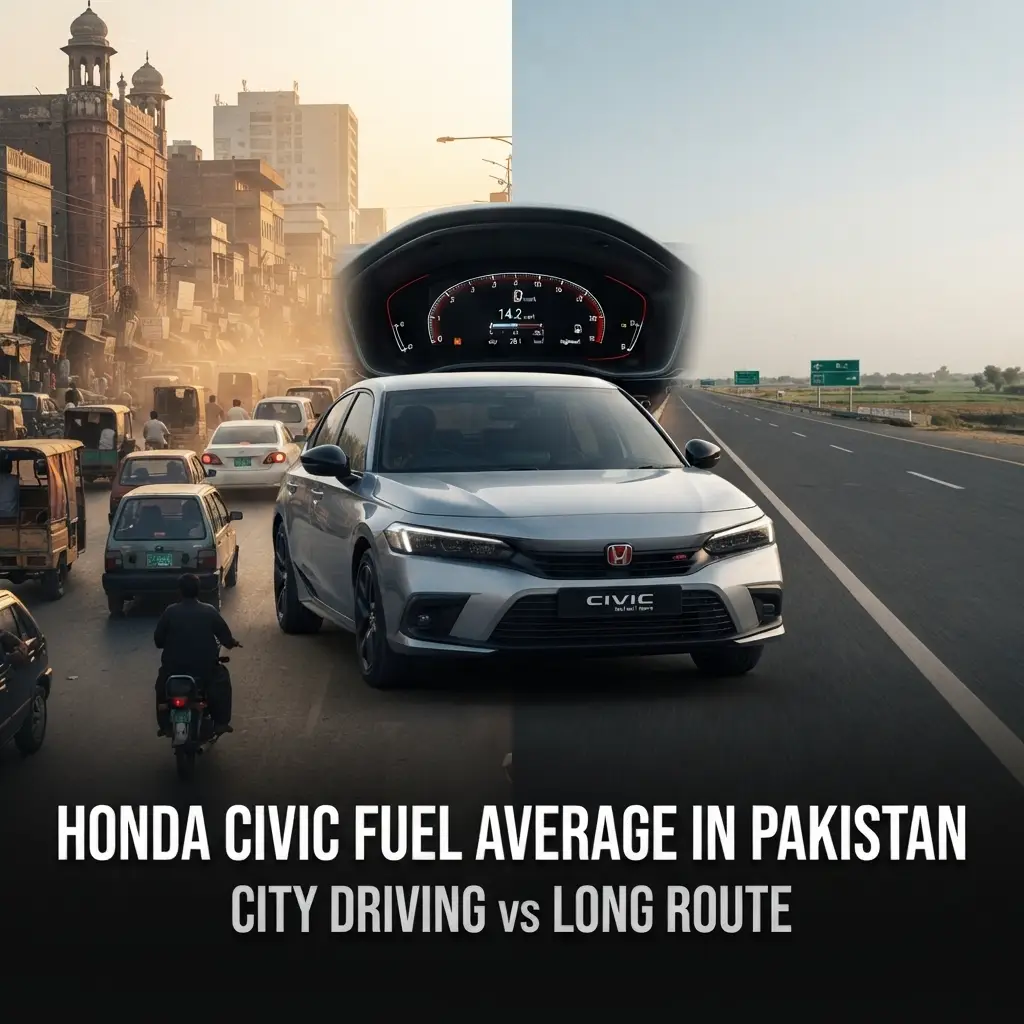
In Pakistan, the Honda Civic is a sedan that has long been favored for its comfort, performance, modern design, and driving experience. Whether buying a new car or already owning one, almost every owner asks the same question:
What is the Honda Civic’s fuel average in Pakistan?
While the question seems simple, there is no single, fixed answer. The same Honda Civic can yield different fuel averages for different drivers; a car driven in Lahore’s heavy traffic will not have the same fuel consumption as the same model driven continuously on the motorway.
Fuel average is influenced by numerous factors, including city traffic, driving style, vehicle condition, tire pressure, air conditioning usage, engine oil, fuel quality, the route taken, speed, and maintenance.
Therefore, instead of simply citing a single mileage figure, this guide explores in detail why there is a difference between city and highway mileage, what factors affect fuel average, and how Civic owners can improve their vehicle’s fuel efficiency.
What is the Honda Civic’s fuel average?
Fuel average refers to the distance a vehicle travels on a specific amount of fuel.
In Pakistan, this is typically measured in kilometers per liter (km/L).
For instance, if a car’s dashboard displays a certain km/L figure during a specific trip, it does not mean the car will deliver that exact average on every road, in every season, or under every driving condition.
This is why two Honda Civic owners driving the same model might report different fuel averages.
One driver might commute daily over short distances on congested roads, while the other primarily drives on the motorway or open highways.
Since their driving conditions differ, it is normal for their fuel averages to differ as well.
Why can’t the Honda Civic’s fuel average in Pakistan be defined by a single number?
When searching online, users often encounter varying mileage figures.
One source might list a specific number, while another shows a higher figure and a third shows a lower one. A major reason for this difference is that real-world fuel economy differs from the results obtained in a controlled test environment.
In Pakistan, driving conditions can vary not only between cities but also across different routes within the same city.
For instance, during morning or evening rush hours in Lahore, a single route might involve frequent:
- Traffic signals
- Braking
- Acceleration
- Slow-moving traffic
- Idling
Conversely, on the motorway, a vehicle can maintain a relatively stable speed for an extended period.
Therefore, when discussing the Honda Civic’s fuel economy, it is more useful to distinguish between city driving and long-distance (highway) driving.
Honda Civic Fuel Economy: City Driving
City driving generally presents a more challenging environment for a vehicle in terms of fuel consumption.
In a major city like Lahore, a driver may encounter traffic signals, congestion, U-turns, intersections, and the need for frequent braking.
The vehicle undergoes repeated acceleration and deceleration.
This stop-and-go pattern can impact fuel efficiency.
If you use your Honda Civic for a daily office commute primarily on congested urban roads, it is normal for the fuel economy figure displayed on the dashboard to differ from that of an open highway drive.
How Does Heavy Traffic Affect Fuel Average?
In heavy traffic, the vehicle covers less distance but the engine keeps running.
For example, you are standing at a traffic signal.
The vehicle is not moving, but the engine is ON and the air conditioning is also running.
Fuel is being consumed, but the vehicle is not covering the distance.
If the same situation happens again and again throughout the route, the overall km/L can naturally decrease.
So just saying:
“My Civic is giving low fuel average”
Not enough.
It should also be seen in which environment the car is running mostly.
Stop-and-Go Traffic and Fuel Consumption
Stop-and-go traffic in city driving can have a significant impact on fuel economy.
When the vehicle re-accelerates from a stationary position, the engine experiences different load conditions compared to cruising.
If the driver repeatedly performs aggressive acceleration and then immediately applies the brakes, the fuel consumption can increase further.
Smooth acceleration and driving in anticipation of traffic can help improve fuel efficiency.
This does not mean that the driver runs dangerously slow.
The aim is simply to reduce unnecessary hard acceleration and sudden braking.
Effect of Air Conditioning on Honda Civic Fuel Average
In Pakistan, especially during summer, Air Conditioning is not an optional luxury but a practical necessity.
In Lahore and other cities AC can be used continuously during hot weather.
The air conditioning system can put additional load on the engine, which can affect fuel consumption.
This effect can be particularly noticeable in city traffic because the vehicle is already running in slow speed and idling conditions.
Therefore, the fuel average of the same vehicle may look different in summer and winter.
But it is not appropriate to turn off the AC in extreme heat to drive uncomfortable or unsafe just to get better mileage.
Fuel economy should always be balanced with comfort and safe driving.
Honda Civic Long Route Mileage
Now consider Long Route Mileage as compared to City Driving.
In long route or highway driving, the vehicle usually gets a chance to maintain a more consistent speed.
Frequent traffic signals, braking and repeated acceleration can be relatively low.
That’s why many drivers observe better fuel average during long journey than city use.
For example, the Lahore to Islamabad Motorway journey and the peak-hour commute within Lahore are fundamentally different driving environments.
On the motorway, the vehicle can maintain steady movement for a long time, while in city traffic, the same vehicle stops and accelerates repeatedly.
This is the reason that Honda Civic Long Route Mileage can generally be better than city mileage, but the actual result will depend on speed, load, weather, tires, maintenance and driving style.
Why is Stable Speed Important on the Highway?
When the vehicle is not accelerating and braking repeatedly, the engine can remain in a more consistent operating condition.
Therefore, smooth cruising can be beneficial for fuel efficiency.
But here is a misconception to avoid:
The faster you go on the highway, the better the fuel average — not true.
At high speeds, aerodynamic resistance can increase, causing the engine to require more energy to keep the vehicle moving.
Therefore, safe and steady driving is a more suitable approach for fuel efficiency than aggressive high-speed driving.
Always follow posted speed limits and road safety rules.
City Driving vs Long Route – What’s the real difference?
The difference between the Honda Civic’s City and Long Route Fuel Average is not just because of the length of the road.
The real difference is the driving pattern.
In City:
Frequent Stops → Acceleration → Braking → Idling → Traffic → AC Load
Often in Long Route:
Steady Movement → Fewer Stops → Consistent Speed → Less Idling
This difference can significantly influence the overall fuel consumption.
Therefore, if a friend’s Civic is giving better mileage on long route and your car is showing comparatively less in Lahore city traffic, then it is not always fair to directly compare the two figures.
Compare driving conditions first.
How Much Does Driving Style Affect Fuel Average?
Vehicle technology is important, but driver behavior also plays a large role in fuel average.
Two people can drive the same Honda Civic on the same route and still observe different fuel consumption.
The reason may be the difference in acceleration, braking, speed control and traffic anticipation.
Hard Acceleration
Applying too much throttle when the signal is green can increase fuel consumption.
Building speed smoothly is generally a more efficient driving habit.
Avoiding unnecessary rapid acceleration in daily driving can help improve fuel economy.
Sudden Braking
If a driver repeatedly accelerates aggressively and then brakes hard upon approaching traffic, energy is wasted unnecessarily.
Observing traffic ahead and maintaining an appropriate distance facilitates smooth driving.
This can improve not only fuel efficiency but also driving comfort and road safety.
What is Idling, and why does it lower fuel economy?
Idling refers to the engine running while the vehicle is stationary.
This is very common in city traffic.
A vehicle may remain stationary for several minutes at traffic signals, in traffic jams, or while waiting for someone.
During this time:
Fuel is being consumed, yet the distance covered is zero.
Consequently, excessive idling can negatively affect the overall fuel average.
However, deciding when to shut down the engine depends on the situation and vehicle guidelines; one should not switch off the engine in traffic if it is unsafe or impractical to do so.
Why can short trips be challenging for fuel economy?
Many Honda Civic owners primarily use their vehicles for short routes.
For example:
Commuting from home to a nearby office, market, or school (for pick-and-drop), or driving just a few kilometers.
During repeated short trips, the engine and drivetrain may have limited time to reach optimal operating temperatures.
Additionally, if these trips involve heavy traffic and frequent use of the air conditioner, the displayed fuel average may remain comparatively low.
Therefore, looking at the fuel average from just a single short trip is insufficient for judging a vehicle’s overall condition.
Tire Pressure and Honda Civic Fuel Economy
Many drivers immediately blame the engine or fuel quality when fuel economy drops, but tire pressure is also a crucial factor.
Incorrect tire pressure can affect rolling resistance and vehicle handling.
If tires are not maintained at the manufacturer-recommended pressure, fuel consumption, tire wear, and handling can all be adversely affected.
Therefore, tire pressure should be checked regularly, especially before long journeys.
For the correct pressure, follow the vehicle’s recommended specifications rather than relying on arbitrary figures found online.
Wheel Alignment and Fuel Efficiency
If a vehicle’s wheel alignment is incorrect, tires may wear unevenly, and the vehicle may encounter additional resistance while trying to maintain a straight path.
Common signs of an alignment issue include:
• The vehicle pulling to one side
• An off-center steering wheel
• Uneven tire wear
• Changes in driving feel
If such signs appear, it is advisable to have the vehicle professionally inspected.
Proper wheel alignment is crucial not only for fuel efficiency but also for tire longevity, handling, and overall driving safety.
Relation of Engine Oil to Fuel Average
Engine oil provides lubrication between the moving components of the engine.
Wrong specification, poor-quality oil or overdue oil change can affect engine performance.
A Honda Civic owner should always follow the recommended engine oil specification and maintenance interval for the vehicle.
Don’t use a different viscosity or oil just because another driver claims a better fuel average.
Correct specification should be as per vehicle model, engine and manufacturer guidance.
Air Filter and Fuel Efficiency
Engine requires clean airflow for combustion process.
If the air filter is excessively dirty or restricted, engine performance may be affected.
Due to dusty environments in Pakistan, air filter inspection can be particularly important.
Air filter check is useful during regular maintenance and replacement should be according to vehicle maintenance schedule and actual condition.
This is a relatively simple maintenance item that owners often ignore.
Spark Plugs and Engine Performance
Spark plugs play an important role in the combustion process of a petrol engine.
Worn or inappropriate spark plugs can affect areas such as engine performance, starting or fuel consumption.
Replacement interval and correct plug specification should be followed as per Honda model/engine.
It is not necessary to change spark plugs without diagnosis just because of low fuel average.
Proper inspection is the best approach.
How important is fuel quality?
Fuel quality is an important factor for engine performance.
Honda Civic owners should use appropriate fuel from a reliable fuel station and follow the vehicle manufacturer’s recommended fuel requirements.
It is not advisable to use random fuel additives or unverified products just because of the claim of increasing mileage.
If the fuel average suddenly changes significantly, instead of blaming only the petrol pump, one should also check the overall vehicle condition, driving conditions and maintenance.
Vehicle load can also affect mileage
By keeping unnecessary weight in the vehicle, the engine has to work more to move the vehicle.
Constantly keeping unnecessary heavy items inside the boot in daily use can affect the overall efficiency.
In a long journey, passengers and luggage are naturally necessary, so the aim is not to keep the vehicle impractically empty.
The main point is to avoid unnecessary permanent load.
How Reliable is the Honda Civic Dashboard Fuel Average?
In a modern Honda Civic, the driver can monitor the fuel average through the vehicle information display.
The dashboard figure is useful for understanding daily driving patterns, but it should not always be considered an absolute laboratory measurement.
If the owner wants a more accurate real-world calculation, the Full-Tank Method can also be used.
In this, after filling the tank, the trip distance is recorded, then on the next refill, the average can be calculated from the consumed fuel and driven kilometers.
Observing this method over multiple fill-ups can give a more useful picture than a single short trip.
What to do if fuel economy suddenly drops?
If your Honda Civic was previously delivering normal fuel economy but suddenly shows a noticeable decline, you shouldn’t simply dismiss it as a result of your driving style.
First, check the simple factors:
Tire pressure
Driving conditions
Traffic patterns
A/C usage
Recent refueling
Vehicle load
If the decline persists, a warning light appears, the engine runs roughly, or you notice other performance changes, it is best to have the vehicle inspected by a qualified technician.
Proper diagnosis is far better than replacing parts based on guesswork.
How can the Honda Civics’s fuel economy be improved?
You don’t need a “magic product” or a shortcut to improve your Honda Civic’s fuel economy. In most cases, proper maintenance, smooth driving, and adhering to the vehicle’s recommended specifications are what matter most.
A good fuel efficiency strategy can be broken down into three components:
Driving Habits + Vehicle Maintenance + Driving Conditions
Driving conditions aren’t always within the driver’s control. For instance, you can’t eliminate peak-hour traffic in Lahore, but you can better manage your driving habits and vehicle maintenance.
1. Practice smooth acceleration
Accelerating too hard unnecessarily when moving off from a traffic signal can increase fuel consumption.
Press the accelerator smoothly and allow the vehicle to build speed gradually.
This doesn’t mean driving extremely slowly; the goal is simply to avoid aggressive throttle inputs.
In a modern vehicle like the Honda Civic, smooth driving enhances both fuel efficiency and passenger comfort.
2. Avoid unnecessary hard braking
If you can see from a distance that traffic is slowing down or a signal is red, gradually lift your foot off the accelerator and let the vehicle slow down in a controlled manner.
A repetitive pattern of:
Hard Acceleration → Hard Braking → Hard Acceleration
…is not fuel-efficient driving.
Observing traffic flow and maintaining a safe following distance helps facilitate smoother driving.
3. Maintain a safe and consistent speed
On long trips, maintaining a constant and reasonable speed can benefit fuel efficiency.
Drastically increasing and decreasing speed repeatedly can negatively impact fuel consumption. However, exceeding the speed limit solely to improve fuel economy is not advisable.
Safe driving—taking into account road conditions, traffic, and posted speed limits—should always be the top priority.
4. Drive the Honda Civic CVT Smoothly
Relevant variants of the Honda Civic are equipped with a CVT (Continuously Variable Transmission).
The CVT operates differently than a traditional automatic transmission. Applying smooth throttle input helps keep the engine and transmission within their efficient operating range.
Aggressive acceleration can cause engine RPM to rise rapidly, which in turn increases fuel consumption.
For daily city driving, smooth throttle application is preferable to unnecessarily flooring the accelerator.
Always operate and maintain the transmission in accordance with the manufacturer’s guidelines.
5. Anticipate Traffic
Anticipating traffic is an underrated method for fuel-efficient driving.
For instance, if traffic ahead appears slow, there is no benefit in accelerating unnecessarily only to brake immediately.
Similarly, if a traffic signal is red, accelerating until the last moment and then braking hard can waste fuel.
The goal of smooth driving is to understand road conditions in advance and manage vehicle inputs gradually.
6. Minimize Unnecessary Idling
In Part 1, we discussed that the engine consumes fuel while idling, even though the vehicle covers no distance.
If you are waiting somewhere for an extended period, unnecessary prolonged idling can increase fuel consumption.
However, the decision to shut down the engine should be based on road conditions, safety, and the manufacturer’s guidelines.
Manually turning the engine on and off repeatedly while in moving traffic is not advisable.
7. Check Tyre Pressure Regularly
Correct tyre pressure is crucial for fuel efficiency, tyre longevity, braking, and handling.
Maintain tyres at the pressure recommended by the manufacturer.
Specifically:
Have the tyre pressure checked before a long journey.
Judging pressure merely by looking at the tyre is unreliable; it is better to use a proper tyre pressure gauge.
8. Do Not Ignore Wheel Alignment and Balancing
If the Civic pulls to one side on a straight road or the tyres are wearing unevenly, you should have the wheel alignment checked.
Alignment issues can increase driving resistance and affect tyre wear.
Wheel balancing is also important for a smooth driving experience and optimal tyre performance.
Regular inspections are beneficial, especially after driving over potholes or on rough roads.
9. Use Recommended Engine Oil
Using the correct engine oil specification for the Honda Civic is vital.
There are often claims online suggesting that a specific oil or viscosity can dramatically improve fuel economy.
One should not rely blindly on such claims.
It is best to follow Honda’s recommended oil specifications for your specific vehicle model and engine.
Oil changes should also be performed according to the recommended maintenance schedule.
10. Maintain the Air Filter
Inspecting the air filter is important given the dusty environment in Pakistan. A dirty or excessively restricted filter can impede engine airflow.
Have the filter inspected during regular service and replaced based on its condition or the maintenance schedule.
Unnecessary replacement at every service isn’t required; follow the actual condition and the manufacturer’s guidelines.
11. Have Spark Plugs Inspected on Time
Spark plugs play a crucial role in engine combustion.
If there is a noticeable change in the vehicle’s fuel economy, unusual engine performance, or a maintenance interval is due, include the spark plugs in the professional inspection.
Replacement intervals and specifications should adhere to the vehicle manual or authorized technical guidelines.
12. Remove Unnecessary Weight
Keeping heavy, unnecessary items in the vehicle’s trunk for months increases the vehicle’s weight.
The engine has to work harder to move this additional weight.
Therefore, keep the trunk organized and practical.
This does not mean removing the spare wheel, emergency equipment, or essential items; simply avoid carrying unnecessary heavy loads.
13. Don’t Judge Fuel Economy Based on a Single Trip
This is a very common mistake.
Suppose you drive just 5 km in heavy traffic today and see a low average on the dashboard.
This does not automatically mean there is a mechanical problem with the car.
Observe fuel economy across various trips and over a longer period.
Take factors like city driving, long-distance travel, AC usage, and traffic conditions into account.
If the average remains consistently abnormal, then an inspection would be worthwhile.
Honda Civic City Driving vs Long Route Mileage
Now consider both the situations in simple comparison.
Factor City Driving Long Route
Traffic can be high, usually less
Signals high very low
Acceleration/Braking Frequent Relatively less
Idling more or less
Speed pattern change frequently more consistent
AC + Stationary Time can be more comparatively less impact
Fuel efficiency is usually lower, usually better
This table does not guarantee exact km/L. The point is just to explain why the fuel average on a long route can often be better than in the city.
Why Honda Civic Fuel Average may vary in Lahore?
Driving environment in Lahore can be very different from one route to another.
During peak hours:
Traffic congestion, signals, slow-moving traffic, frequent braking and idling may increase.
One driver uses a relatively open route daily while the other passes through congested commercial areas.
The reported mileage of two Honda Civic owners may differ, even if the vehicle model is the same.
That is why it is not practical to define Honda Civic Fuel Average in Lahore with a universal number.
Why might the Honda Civic Fuel Average feel better on the motorway?
Motorway driving allows the vehicle to maintain steady movement for long periods.
Due to the absence of frequent signals and stop-and-go traffic, the engine can remain in comparatively consistent operating conditions.
That’s why the owner can see better mileage on the dashboard compared to city commute.
But even on the motorway the fuel average can be affected by several things:
Driving Speed, Passenger Load, Luggage, Tire Pressure, Weather Conditions, AC Usage, Vehicle Condition and driving behaviour.
Does Driving Very Slow Get the Best Fuel Average?
Not necessary.
The goal of fuel efficiency is not simply to run the vehicle at the minimum possible speed.
Extremely slow driving can also be a problem for traffic flow and safety.
The best approach is to do smooth, safe and consistent driving according to road conditions and speed limits.
Does Cruise Control Improve Fuel Average?
On long routes, cruise control can help maintain a steady speed if available and appropriate.
Consistent speed in flat and suitable road conditions can be beneficial for fuel efficiency.
But cruise control is not for every situation.
Vehicle manual control may be more appropriate in heavy traffic, slippery roads or unsuitable conditions.
Driver should always follow vehicle manual and road safety requirements.
What does Eco Driving mean?
Eco Driving does not mean driving the vehicle very slowly.
This means adopting efficient driving habits:
Smooth acceleration, avoiding unnecessary braking, proper tire pressure, reducing unnecessary idling, maintaining the vehicle properly and consistent driving according to road conditions.
These habits can benefit vehicle wear and driving comfort along with fuel economy.
Common Mistakes of Low Honda Civic Fuel Average
Many times the problem is not in the vehicle but in the usage pattern.
Aggressive Driving
Hard acceleration and sudden braking can increase fuel consumption.
Low Tire Pressure
Incorrect pressure can affect rolling resistance and handling.
Delayed Maintenance
Overdue maintenance can affect vehicle performance.
Excessive Idling
Engine keeps running but distance is not covered.
Short Trips Only
Repeated short trips can cause the fuel average reading to differ from the long-route figure.
Heavy Unnecessary Load
Additional weight can affect vehicle efficiency.
Wrong Maintenance Products
Using incorrect oil specification or unsuitable parts can cause performance issues.
When should the Fuel Average Reset be done on Dashboard?
Resetting the Trip Computer can be useful if you want to see the Fuel Average for a specific journey.
Example:
Lahore City Drive → Reset → Trip Complete → Result
Then on separate Long Route:
Motorway Journey → Reset → Trip Complete → Result
In this way, you can do a City vs Long Route comparison of your own Honda Civic.
This will be more relevant than comparing with another owner’s number on the internet, because the vehicle, driver and conditions will be your own.
How to Check Fuel Average by Full-Tank Method?
A common way to estimate real-world fuel averages other than the dashboard is the Full-Tank Method.
Fill the tank and reset the trip meter.
Drive the vehicle normally.
Note on next refill:
How many kilometers did you drive?
And
How many liters of fuel was refilled?
Then:
Distance Traveled ÷ Fuel Used = Approximate km/L
For example, if the vehicle traveled 500 km and refilled with 40 liters of fuel:
500 ÷ 40 = 12.5 km/L
This is just an example to illustrate the calculation, not the Honda Civic’s claimed fuel average.
A more useful trend can be revealed by recording multiple tank cycles.
When should you go to the service center when the fuel average is low?
Not every low reading is a mechanical fault.
But if the fuel average drops suddenly and consistently, especially if there are other symptoms, an inspection is better.
For example:
Check Engine Light, unusual engine sound, rough idling, loss of power, starting issue, unusual vibration or unusual exhaust behavior.
In such a situation proper diagnosis should be done instead of replacing parts on internet guesses.
Why is Regular Honda Maintenance Important?
Fuel efficiency doesn’t just come from driving technique.
It is also important to maintain the vehicle in proper condition.
During scheduled maintenance, relevant components can be inspected and required servicing can be done as per manufacturer recommendations.
The purpose of regular maintenance is not only to improve mileage but also to maintain reliability, performance, safety and vehicle life.
Simple Maintenance Checklist for Honda Civic Owners
Regularly:
Engine Oil & Oil Filter — as per recommended schedule.
Air Filter — Check condition.
Tire Pressure — As per recommended specification.
Wheel Alignment — According to symptoms or requirement.
Spark Plugs — according to maintenance schedule.
Brakes — regular inspection.
Fluids — according to recommended intervals and specifications.
Battery — condition check.
Warning Lights — Don’t Ignore
It is best to follow the owner’s manual and Honda’s official maintenance recommendations for a vehicle-specific schedule.
What should be avoided in the name of fuel saving?
Many “fuel-saving hacks” can be found online.
Not every claim is reliable.
Be wary of products or modifications that promise a dramatic increase in mileage without credible evidence.
Unauthorized modifications—particularly to the engine, fuel system, or electrical system—can compromise vehicle reliability or void the warranty.
To improve fuel economy, focus on the basics first:
Proper maintenance + Correct tire pressure + Smooth driving + Genuine/recommended parts and fluids.
Frequently Asked Questions about Honda Civic Fuel Average
What is the Honda Civic fuel average in Pakistan?
The real-world fuel average of a Honda Civic varies based on driving conditions, traffic, driving style, maintenance, AC usage, speed, and the vehicle’s condition. Therefore, a single universal km/L figure will not be accurate for every driver.
Does the Honda Civic deliver better mileage on long routes?
Fuel average can be better on long routes compared to city traffic due to steady speeds, less braking, and minimal idling. Actual mileage depends on driving conditions and the vehicle’s condition.
Why is my Honda Civic delivering low fuel average in the city?
Heavy traffic, frequent acceleration/braking, idling, AC usage, tire pressure, and short trips can all affect city mileage.
Does AC usage reduce the Honda Civic’s fuel average?
Air conditioning places an additional load on the engine, which can impact fuel consumption—especially in slow-moving traffic or while idling.
Does tire pressure affect fuel average?
Incorrect tire pressure can affect rolling resistance and vehicle performance. It is best to maintain the manufacturer-recommended pressure.
Can engine oil affect fuel economy?
Engine oil is crucial for engine lubrication and performance. You should adhere to the correct specifications and recommended maintenance intervals for your vehicle.
Does aggressive driving consume more fuel?
Frequent hard acceleration and sudden braking can increase fuel consumption. Smooth driving is generally more fuel-efficient.
Why does my Civic show a better fuel average on the motorway?
Steady movement, fewer stops, and minimal idling on the motorway allow the vehicle to operate under more efficient conditions.
Is the dashboard fuel average reading accurate?
The dashboard fuel average provides a useful estimate for daily monitoring. Real-world fuel consumption can also be calculated using the “Full-Tank Method.”
How can I improve my Honda Civic’s fuel efficiency?
Smooth acceleration, correct tire pressure, regular maintenance, minimizing unnecessary idling, and safe, consistent driving can all help maintain fuel efficiency.
Honda Ring Road – Honda Civic Maintenance & Inspection
If your Honda Civic’s fuel efficiency has suddenly dropped or the vehicle’s performance doesn’t feel quite right, it is not appropriate to blame a single component based solely on the mileage figure.
It is essential to consider the vehicle’s overall condition, maintenance history, and driving conditions.
Honda Civic owners can contact Honda Ring Road for professional inspections, periodic maintenance, and relevant vehicle services.
Identifying the actual issue through proper diagnosis is a better approach than replacing parts unnecessarily.
Is Your Honda Civic Giving Lower Fuel Efficiency Than Usual?
Contact Honda Ring Road for your Honda Civic’s scheduled maintenance, inspection, and service requirements.
Book a Service | Schedule an Inspection | Contact Honda Ring Road
Conclusion
It is not accurate to judge the Honda Civic’s fuel efficiency in Pakistan based solely on a fixed mileage figure.
In city driving, fuel consumption can increase due to traffic, signals, idling, frequent acceleration, and AC usage, whereas steady driving conditions on long routes can contribute to better fuel efficiency.
Additionally, factors such as driving style, tire pressure, wheel alignment, engine oil, air filters, spark plugs, vehicle load, and overall maintenance play a significant role.
If you want better fuel economy from your Honda Civic, the most practical approach is:
Smooth Driving + Proper Maintenance + Correct Tire Pressure + Recommended Parts/Fluids + Safe Driving Habits
And if fuel efficiency drops significantly or any other unusual symptom appears, it is best to get a proper professional inspection.